Why does Kathy dither over black skates?: A short, illustrated history of figure skating boots
At one point while working on Edge Closer, I got a question from someone who isn't deep into figure skating. They were curious about a scene where Kathy is thinking about how she wishes she could wear black boots: Is it really that much of a big deal what color your skates are?
The answer yes, and that as silly as it may sound, boot color - white or tan for women, black for men - is one of the most deeply entrenched gender-based traditions in a sport that already holds very fast to old-fashioned gender norms.
I can think of exactly one woman high-level skater who I have seen try wearing black boots; this was almost a decade ago. People commented on it, and usually not positively, at every competition she appeared in until she switched back mid-season. Men's skaters always wear black skates after childhood (when he might have worn a sister's hand-me-downs to save money), outside of situations where an airline loses someone's skates and white is the only option available from local fitters. (Yuzuru Hanyu once wore white boot covers to match white pants, though he quickly switched the costume out for a purple one.) I would be deeply surprised to see elite men start voluntarily wearing white skates anytime soon. The funny thing about this, though, is that originally, women and men and everyone else wore black skates! Editing this scene inspired me to look more closely at this piece of history, so let's do a little walk through it together.
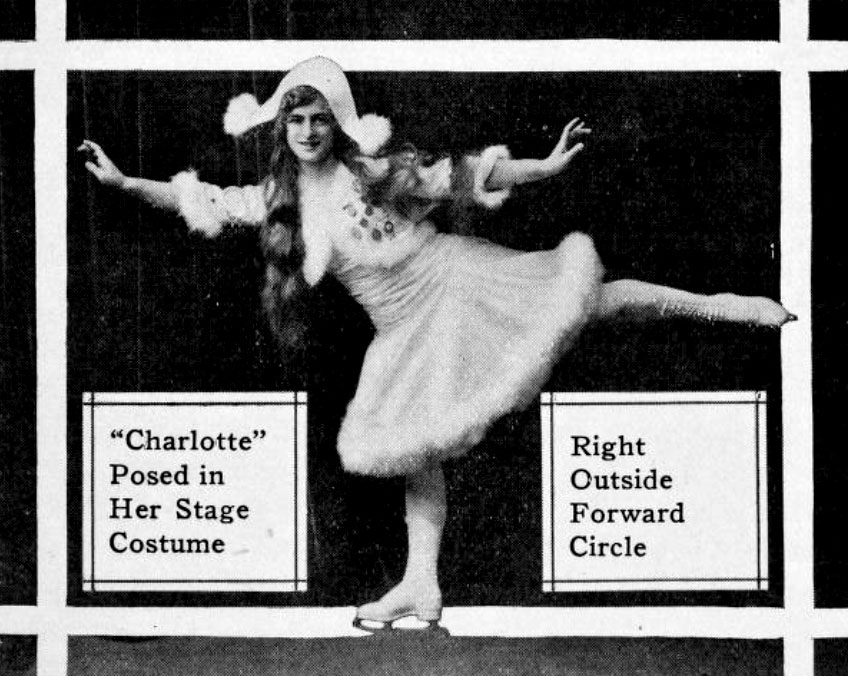
The earliest example I've personally seen of white skates are on "Charlotte", the stage name of Charlotte Oelschlägel. She was a professional show skater who wore white boots, white tights, and sometimes knee-length skirts way back in the 1910s. Her performances in New York City were extremely popular, and she also toured in many other countries as well. You can see various examples of her costumes in a book she published. Interestingly, she also writes that women and men could skate equally well - this was when competitive skating primarily consisted of skating "figures" rather than performing programs with multi-rotational jumps.
Other photos of women show skaters from this era sometimes show them wearing white boots as well. However, high-level competitive skaters continued to wear black skates. They often wore dark tights to match as well, though not always:

But in 1928, something changed. Sonja Henie, who went on to win multiple Olympic golds as well as a bunch at the World Championships, showed up in... well. The conventional narrative that I first learned and that you might see is that she was the first to wear white skates, made them fashionable, then switched over to tan ones to remain ahead of her competitors in the fashion game. But if you actually look at the pictures, while it can be hard to tell the exact color, in most of them it seems like she first switched from black to tan, not white:

A Canadian skater, Cecil Smith, claimed that she was the one who started the trend to white in the competitive ranks in 1930, and that Henie was copying her. Is this true? Well, here's the women competing at the 1930 World Championships, wearing a variety of boots; Smith is in white, and Henie's look like they're some shade of brown or gray. So while these are only a few photos, I find Smith's story believable.

Not everyone switched over right away, of course, but within five years, the picture looks quite different - at least for singles skating. Pairs women continued to wear dark tights and dark skates for longer, though they also changed fashions by the end of the decade. I think the reason dark skates lingered longer in pairs skating was that pairs women wanted to visually match their partner. Some pairs women also tended to be older, but I'm not sure this was a factor; in the photo of pairs below, the woman in the middle wearing white or pale tan skates is Zofia Bilorówna. She was probably one of the oldest in the photo at 39 years old.


Since the 1930s, a lot has changed in figure skating. Jumps have become a predominant element of the sport, figures are gone, and women can wear trousers/unitards - although wearing anything other than trousers, including tights, on the lower half remains banned for men, alas. Women can even wear pants in ice dance, which only changed the MUST WEAR SKIRTS rule in 2022. (No, that's not a typo.) But the skates? There's no rule about their color, and there never has been. The tradition here just runs even deeper than the rules. When women wear unitards with dark legs, they will almost certainly leave their white skates peeking out rather than adding covers to match.
I have never been an elite skater; things are a lot looser for adults, who might wear the "wrong" color for reasons of gender, fashion, budget, or foot size/shape. People often react positively to a surprising choice of boots or laces, in fact. But I've also had fitters absolutely refuse to fit me in the color I wanted, saying that the last wouldn't be the right shape - then pushed skates on me that had severe fitting issues (so much for the gender-conforming last). That's not the only weird experience I've had or heard of my friends having around fitters and skate companies simply due to skate color. For instance, I know someone who made an appointment with a new blade sharpener where they specified they were getting their own skates sharpened, showed up, and was asked how their nonexistent child of the other gender liked the skates.
So, for a national-level skater like Kathy, black skates, or even covering her white skates with black boot covers, would be very unusual and would certainly draw comments. It made sense as something for her to want as something that would fit her sense of fashion and gender presentation but that she might be afraid of having for herself. (In the future, of course, when she needs new skates, she gets them in black and goes on with her life. Ava, on the other hand, would love a sparkly metallic purple pair. Maybe one day she will test out whether the pretty tape used on rhythmic gymnastics supplies can safely stick to a pair of boots....)